

Diese Seite im Deutschen Original lesen
Swastikas in Birla Mandir
After a hearty breakfast of delicious poha (which is flattened rice with spices and roasted peanuts), we set off with freshly polished shoes to visit the Birla Mandir. This Hindu temple was inaugurated in 1939 by Mahatma Gandhi on the condition that people of any religion and from all castes may visit it. Very laudable and at that time not at all self-evident.
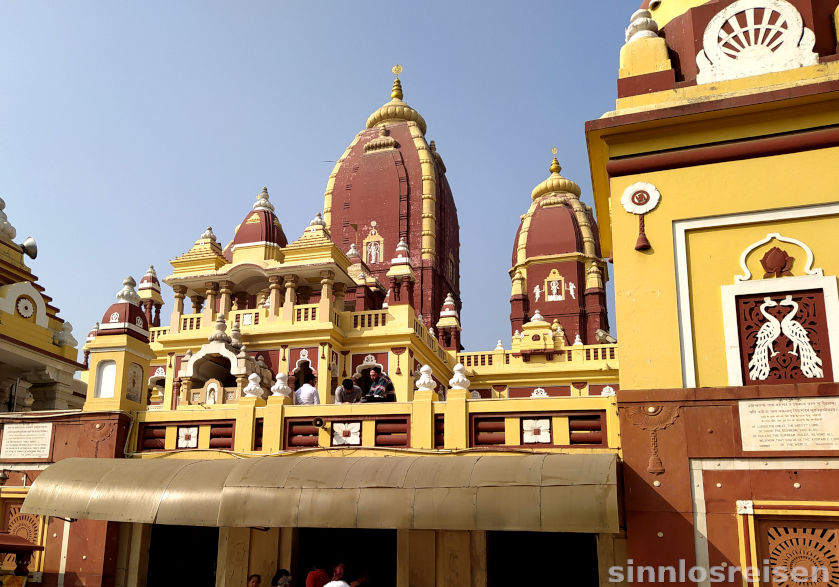
From the outside, the temple looks quite appealing with its yellow facade and rust-red turrets. The interior is quite shocking for a German visitor: swastikas are hanging on the walls everywhere. This seems quite strange at first, but the swastika has been a symbol of good luck in Hindu mythology for thousands of years, long before the Nazis misused it for their propaganda. Inside the temple there was again a strict ban on photography and this time I didn’t find a photo archive on the website. Maybe it’s better that way, because photos with swastikas quickly lead to the blocking of an actually harmless blog.
Aliens in Jama Masjid
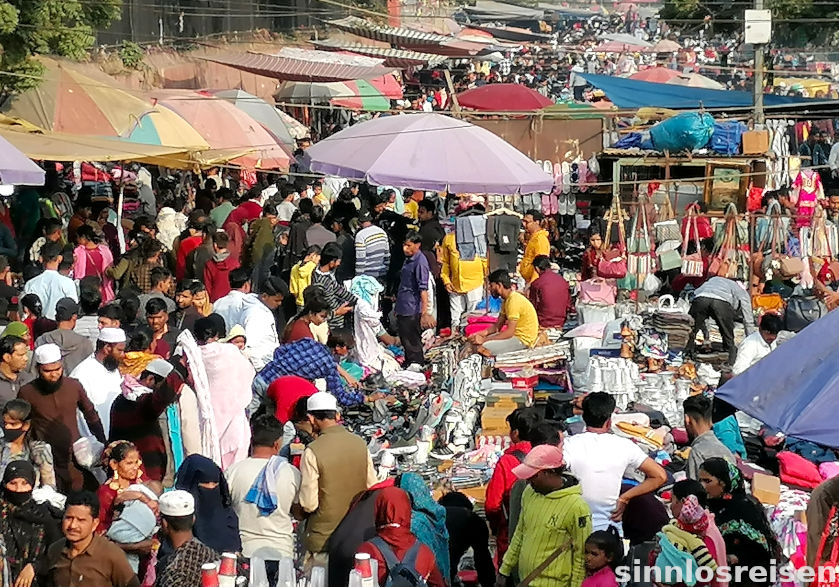
We took the metro to the Jama Masjid, the largest mosque in India, which can accommodate more than 25,000 believers. To get to the entrance, however, you first have to wade through a huge market where so many people crowd that there are always scuffles for the last oxygen atoms in the air you breathe. Delhi had already won the title of the city with the greatest air pollution in the world in 2014 and this area was the mother of polluted air. .
The welcome culture in this mosque was a bit strange: a uniformed man threatened Mrs. SinnlosReisen with a cane as a greeting. She had dared to approach the entrance gate while I was still standing at the ticket counter. As she looked down at the thin little man who was loudly scolding her in an incomprehensible language, this vertical furrow formed on her forehead, of which I knew from my own experience that it heralded disaster. Shortly before the SinnlosReisende could knock this Rumpelstiltskin parody out of his sandals, I came with the tickets and the situation relaxed.
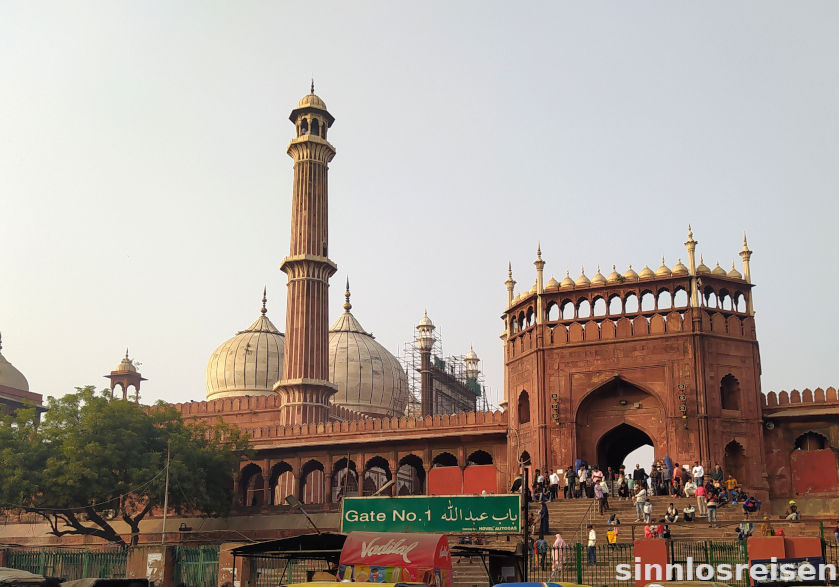
The mosque itself is rather unspectacular despite its size. The main attraction that day were two exotic, strange looking aliens who had just landed with their spaceship. At least that’s what the locals thought and quickly took a few snapshots.
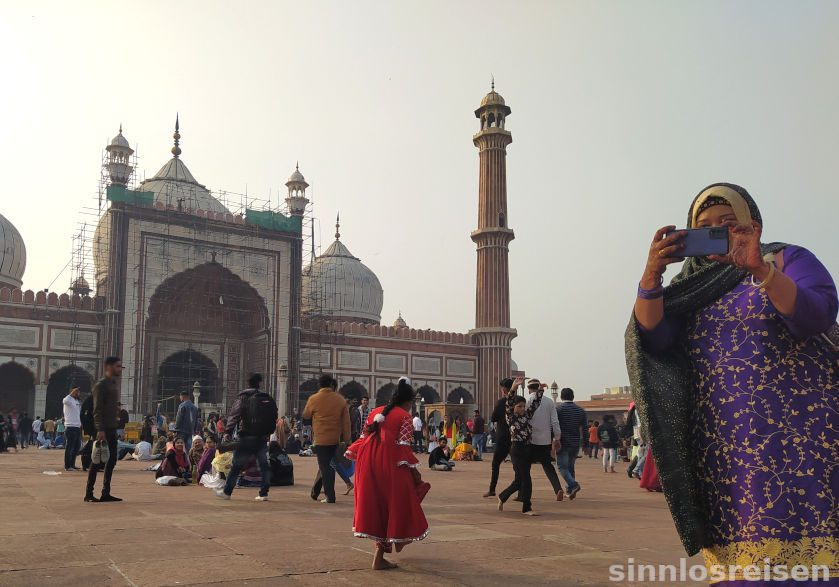
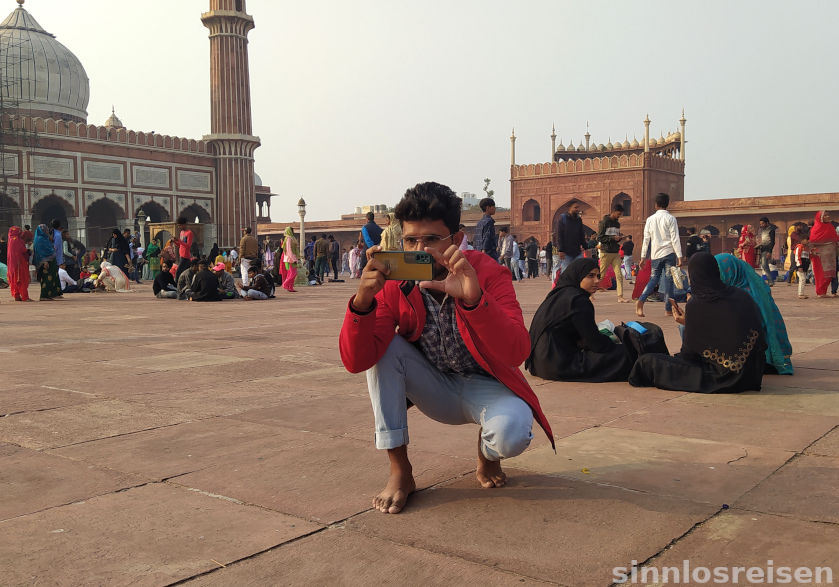
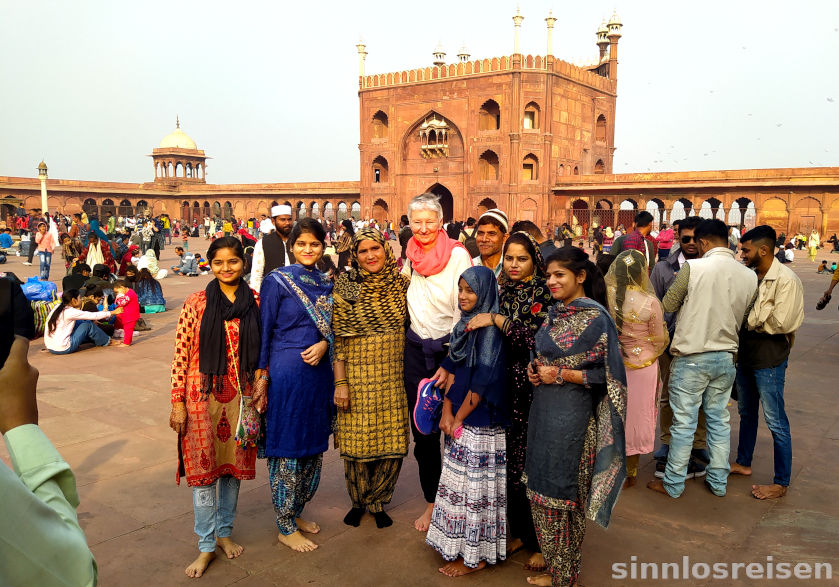
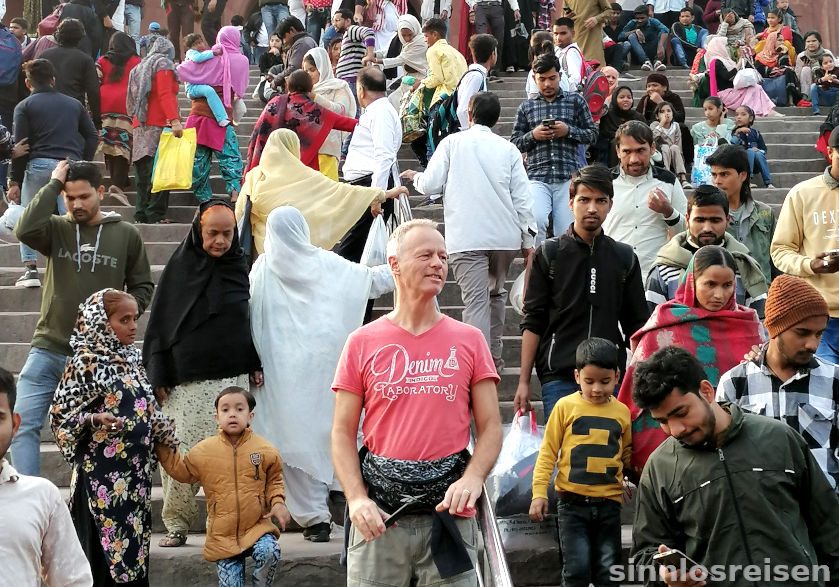
It’s a funny feeling when you alone look so different from everyone else, especially since some of the bystanders stared at us quite blatantly. A few brave ones asked us if we would pose for a photo with them. After a while, a line formed behind us with people waiting for a photo shoot with us. At some point we had to escape, because we still wanted to take a taxi to Humayun’s Tomb.
Driving with Taxi in India
Riding a taxi as a tourist in major Indian cities is about as much fun as inflamed hemorrhoids. It’s just a pain in the ass. To start on a positive note, most taxi drivers are excellent drivers and have a virtuoso way of using the horn. I had already described that traffic in India is a war with high losses. The taxi drivers are the professional soldiers, the mercenaries, the legionaries on this battlefield. Their maneuvers, however, are not always compatible with the principles of German traffic regulations. The best thing to do is not to look out of the window and trust their driving skills.
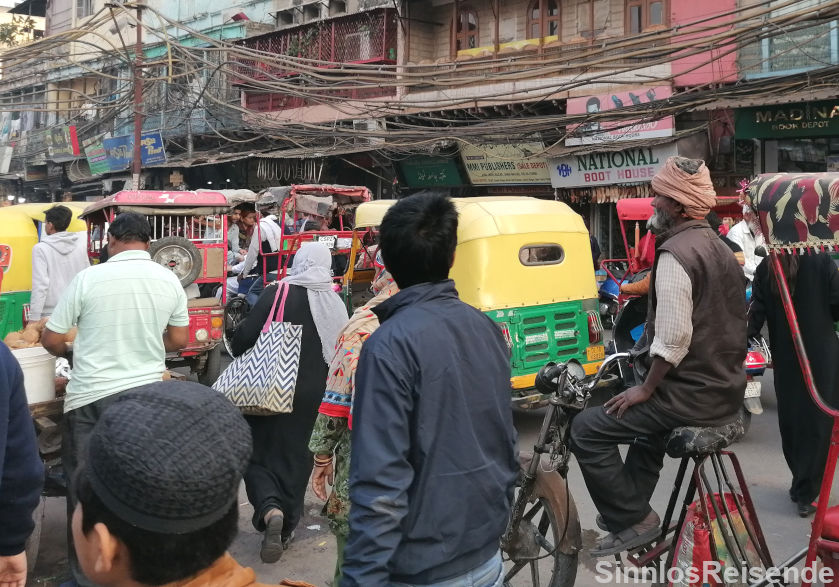
Unfortunately, tourists are not considered customers by Indian taxi drivers, but victims to be ripped off. We did not see a single taxi where the taximeter worked. When negotiating prices, four to five times inflated prices are quoted at the beginning. Even if you have agreed on a reasonably fair price after tough negotiations, you are not safe from surprises. Common arguments when paying are:
- the agreed price was per person, in case of two passengers it doubles
- the luggage costs a surcharge
- a value added tax, city tax, highway tax, airport tax, license fee or tourist tax is added to the agreed price
- the driver simply quotes a higher price than when driving off and suddenly no longer understands English
- it becomes more expensive because a detour was necessary due to a closure
- the agreed price was the daytime price, after dusk the night surcharge is added
- the driver needs a birthday present for his wife
- the driver miscalculates the change in the hectic (always in his favor)
- and of course the classic for people who only pulled big bills out of the ATM: „sorry, I don’t have enough change“
With such tricks, the most effective countermeasure is to suitably pay the agreed amount and simply leave the scene. The price negotiations are annoying, but much worse is that you can never count on being taken directly to the desired destination. Many drivers earn a commission when they deliver their passengers to a carpet store, a jewelry store or a tailor „Just look, you don’t have to buy.“ And sometimes you end up somewhere else entirely, as our group 3 had to experience in Agra. Instead of the „Taj Mahal Viewpoint“, the tuk-tuk driver took them to the „Taj Mahal View Hotel“, which was five kilometers in the opposite direction. All attempts to intervene, even with a route planner on the cell phone, failed due to the driver’s persistent „I know, I know, trust me!“.
The best weapons against the unfair methods of taxi drivers are Uber and Ola. Until now, I had considered these apps unnecessary, because why do you need private drivers when there is an entire profession that transports people professionally? But in India, these apps have been our salvation. You just enter the destination and the algorithm calculates the complete price and looks for a driver nearby. Once someone accepts the ride, you find out their license plate and both receive a pin. Then you can watch live with GPS as the driver gets closer. When you arrive at your destination, the payment is processed without any discussions and you give a rating. Done.
Humayun’s Tomb
Pardon, who? Humayun? Never heard of him. That must have been your first reaction. Fortunately, there is this blog, which immediately closes all possible knowledge gaps. Sometimes with useless knowledge, but no matter, the main thing is that the hole is closed and remains tight.
You can read details on the Unesco World Heritage site itself. In a nutshell: Humayun was an important ruler from the Mughal dynasty in the 16th century. So important, in fact, that his wife and son didn’t just bury him in Delhi’s municipal cemetery, but built him a megalomaniacal mausoleum. Including a ten-hectare garden complex modeled like the Islamic paradise. So not exactly an expression of modesty, but still beautiful to look at today.
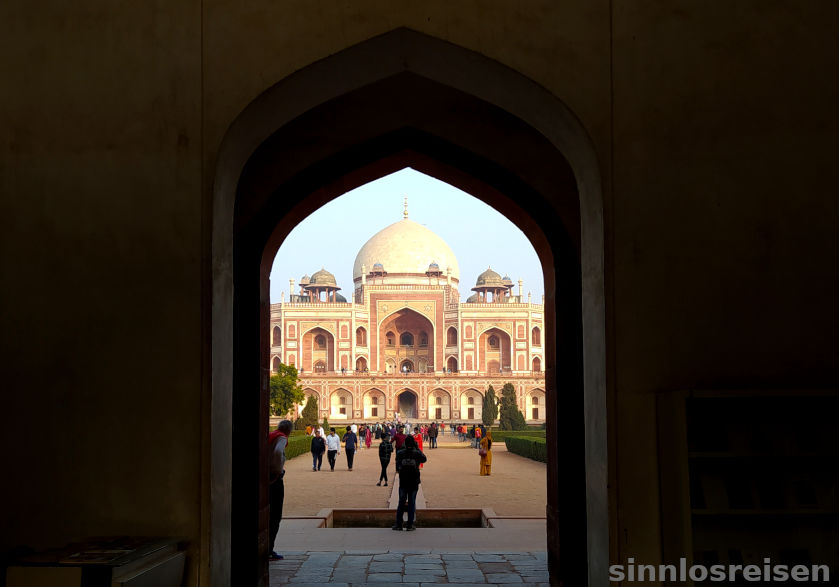
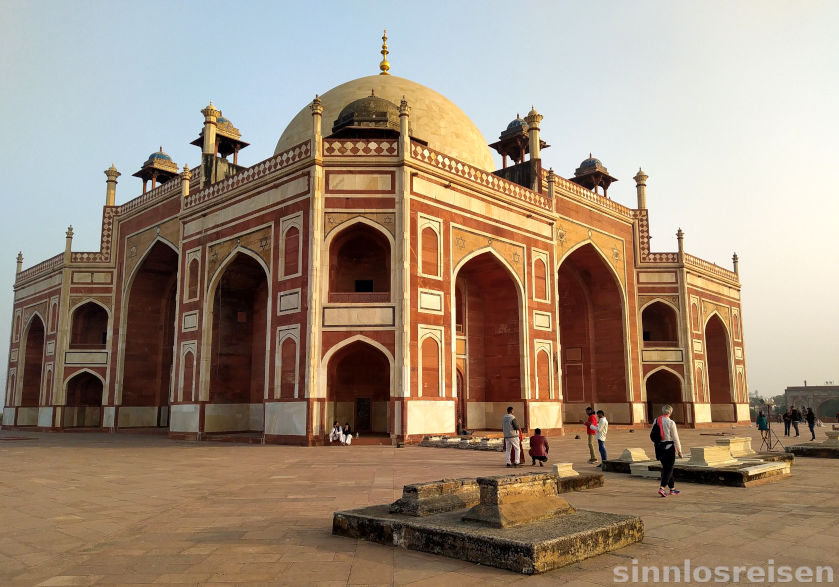
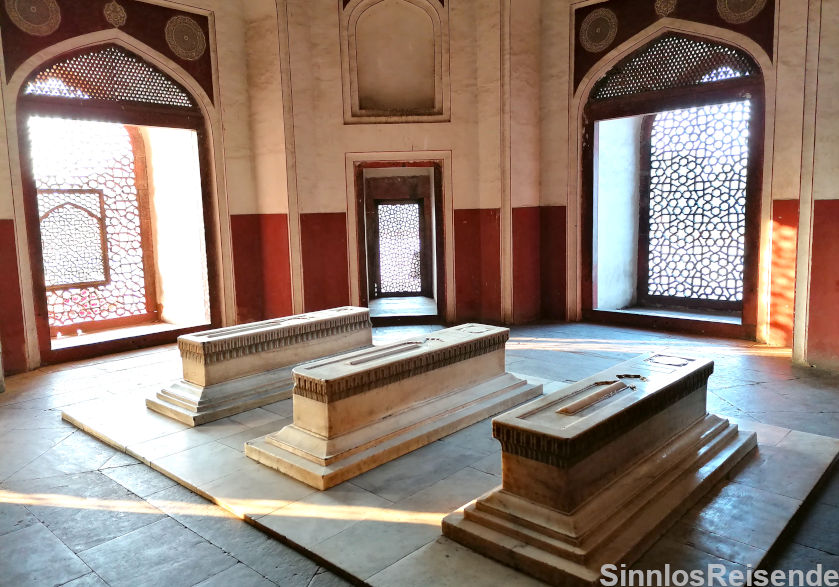
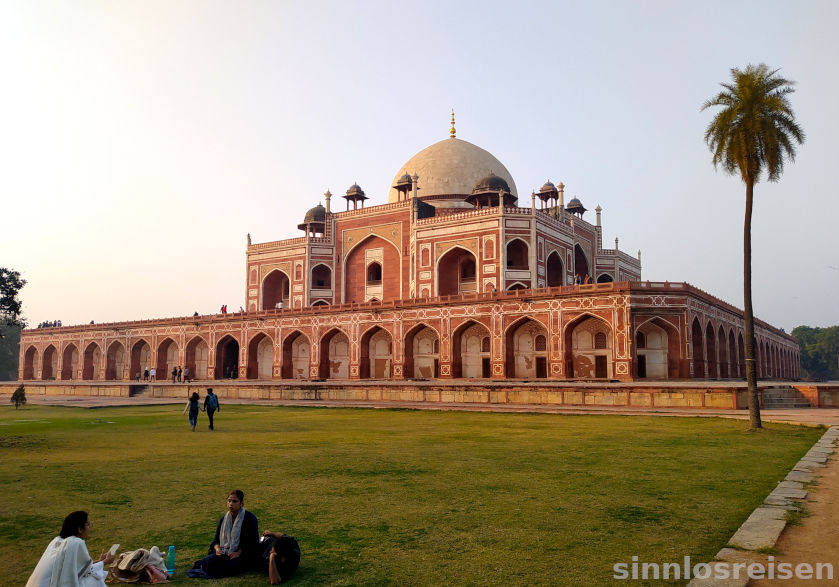

Need a few more useless facts? Then take this: India has over 1.4 billion people. If every Indian would afford a grave like colleague Humayun, you would need an area of 140 million km2 . This would cover the entire land area of the earth (without Antarctica) completely with gravestones. It’s a good thing that in India the space-saving cremation has prevailed.
Humayun’s Tomb, by the way, was the first tomb in a whole series of monumental buildings that culminated in the Taj Mahal. And that’s where the next part of our journey will take us. See you soon.
 Sinnlos reisen